
part 44
Rokgard: rules, score and leaderboard
In Rokgard (Colony and Lines) no score is counted; experience and Golden tokens are paid. The rules card is read from game data, and the leaderboard keeps records, not games. Achievements are in the second part.
The game Audamir has two realms with games. Kastgard is the world of dice and territories: a win there gets a score, and the score goes into the leaderboard. Rokgard is the world of board games against the AI: Colony, a game without dice from the article on Colony, and Lines (Slovak "Čiary"). No score is counted in Rokgard. Payment is made in experience (XP), which makes up the level of the realm, and in Golden tokens, the currency of the realm.
This article is the first part of a pair. It covers what Rokgard pays, how the rules card shows it, and why the leaderboard counts records. The ten achievement chains, the ledger, the migration of old games and the tile in the hub are in the second part.
Two of the November changes are here: the card with the payment rules (1 November 2026) and the Rokgard leaderboard (3 November 2026). The game is in development version 0.97.1; none of it is deployed or published to players.
| Change | Version | Date |
|---|---|---|
| Card "Rules and score" in the Rokgard window | 0.84 | 1 Nov 2026 |
| Rokgard leaderboard | 0.97 | 3 Nov 2026 |
The version numbers are from today's change log. After the merges the minor versions were renumbered by the order of the changes, so some differ from the numbers they had when they were made. The pictures show the build numbers the game had on that day: the card was in build 0.81.2, the leaderboard in 0.97.1.
What is paid in Rokgard when nothing is scored
Kastgard's leaderboard counts one number, the points of a won game. A game against the AI has none, so payment is made for what can be counted: 0.5 XP for every move of the player, multiplied by the strength of the AI (×0.5 for the Weak, ×1 for the Normal and ×2 for the Strong one). A draw pays half, a loss nothing, and every XP paid brings one Golden token. The numbers are in the data of both games (PAY in ColonyData and ChainsData). Why payment follows moves, and why it doubles against a stronger AI, is explained in article no. 27 "How much a win costs" and article no. 29 "Every world its own currency".
| Weak | Normal | Strong | |
|---|---|---|---|
| multiplier | ×0.5 | ×1 | ×2 |
| XP per move | 0.25 | 0.5 | 1 |
| moves of a typical win in Colony | 52 | 59 | 58 |
| XP for a typical win | 13 | 30 | 58 |
The row "XP per move" is my own calculation. A typical win against the Normal AI is 0.5 × 59 = 29.5 XP, which the game rounds to 30.
Lines pay at the same rate, but the board changes it. A board of 36 squares or more pays in full, a smaller one proportionally. A board that the first mover wins quickly (without gravity and with a line of length at most 4) pays a quarter. A game with fewer than two moves per stone of the line pays nothing (with a line of length 4, fewer than 8 moves). The reason is the rule against farming: a win on a solved board would be the cheapest result there is. Three in a row (tic) has its own article no. 25.
Level n starts at 25 × n² XP: level 2 at 100, level 5 at 625, level 10 at 2,500, level 20 at 10,000 and level 30 at 22,500 XP. According to the model (5 seconds per human move, 30 seconds per game), a level 2 player earns 149 XP an hour against the Normal AI, and a level 3 player earns 274 against the Strong one. Level 30 thus comes to about 151 hours against Normal and about 82 against Strong AI. This is an estimate: nothing was measured with a human.
The comparison with Kastgard is in article no. 38 "How many hours to level 30".
The rules card read from data (0.84)
Until then the rules window had only the Kastgard card. The request of 1 November asked for Rokgard to have rules and a leaderboard too, and for the home screen footer to show both realms. A hand-written paragraph saying that a win pays half an XP per move would stop being true the day someone changes the rate, and nobody would notice. So the decision was different:
- A platform table above the registry. A new file,
js/ui/pay-rules.js(PayRules), knows no realm and no game. The application tells it which games have a board and what the currency is called; the rate, the multipliers, the tokens, the board rule and the level curve come from theEconomyregistry. - One new member of the core:
Hero.xpAt(level, realm), the level threshold for any realm. Before, it could only ask about the Kastgard curve. - The Rokgard hook writes only words (the realm has no score, a win pays XP and Golden tokens, a button leads to the guide) and has no number at all.
That the source has no numbers is guarded by a test, not by agreement: one test reads the source without comments and looks for the names of realms and games and for the numbers of the payment tables. Another registers a test realm with a changed rate, multiplier, currency, board rule or curve, and checks that the text changes. The document of the game lists 22 mutations of the source, all killed.
The footer opened the wrong card. Its "Leaderboard" and "Rules and score" links did not send the hub of the realm the player is in, so they opened the card of the last game's realm. Now they open the card of the realm whose hub the player is in.
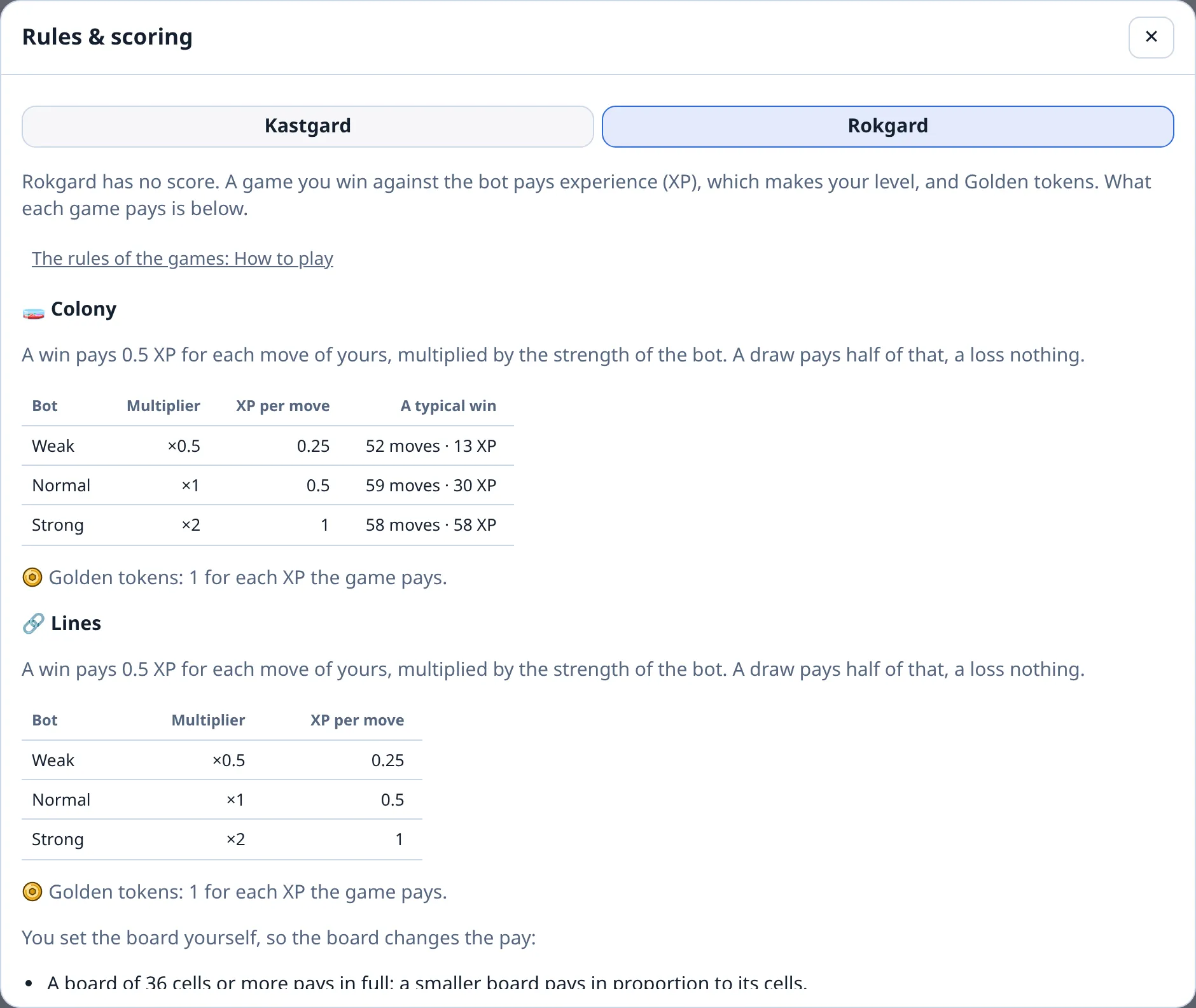
Verification: nine new tests; the Kastgard card drawn by the old and the new tree is the same, apart from two attributes that the window gives every tabbed card. In a real browser, 40 states passed (languages, 375 and 1100 px widths, light and dark theme) with no horizontal scroll. The payout was not rebalanced. The document notes that tokens grow more slowly than Golden dice and that level 30 takes longer in Rokgard; the card only makes this readable.
The Rokgard leaderboard (0.97)
The leaderboard has been in development since 3 November. The analysis of 1 November used 42 real games against the AI and one finding that decided its shape: the only number a Rokgard game naturally has is its XP, and it grows with game length (see article no. 22 "The score that did not know"), so first place would go to the slowest win. The leaderboard is therefore a table of records, not a list of games: the fastest win, the longest streak and, in Colony only, the largest win by board and AI level.
The analysis also found that all twelve Three in a row games in the sample paid 0 XP, and the sample's fastest "win", in three moves, paid nothing. It recommended counting only games that paid, and only against the Normal and the Strong AI. The decision on its twelve questions (LB1 to LB12) was made on 1 November, and in two of them it differed from that advice: all three AI opponents count (the AI level is a row of the table), and every win counts. A record is the best in its cell, so repetition does not inflate it. Thus a win in Three in a row in three moves is a record, even though it paid nothing. One game thus answers three questions:
| Entry | What it asks | A game that paid nothing |
|---|---|---|
statistics (games) | how many games were played | counted |
achievement ledger (ach) | what paid | not counted |
records (rec) | best in the cell: game × board × AI | counted |
Records and the achievement ledger (see the second part) share no numbers, only one rule of streak and margin, written once. Records sit under rec, not under games as the analysis suggested, because a game's record is rewritten whole each time. Old games get their records from the history, never better than the truth. The largest win is estimated as a lower bound, 2 × figures − squares, and the card does not mark it yet.
Verification: 23 new tests and 32 mutations of the source. Thirty were killed at once; two survived the first run and were killed by the new tests. A tool over the data of the old code (34 profiles, 1,776 games) was run as well. In a browser, a real Three in a row game against the Weak AI wrote rec.chains.tic.1 = { fast: 3, big: 0, run: 3, best: 3 }. Not seen: keyboard control of the strip of games and a real profile.
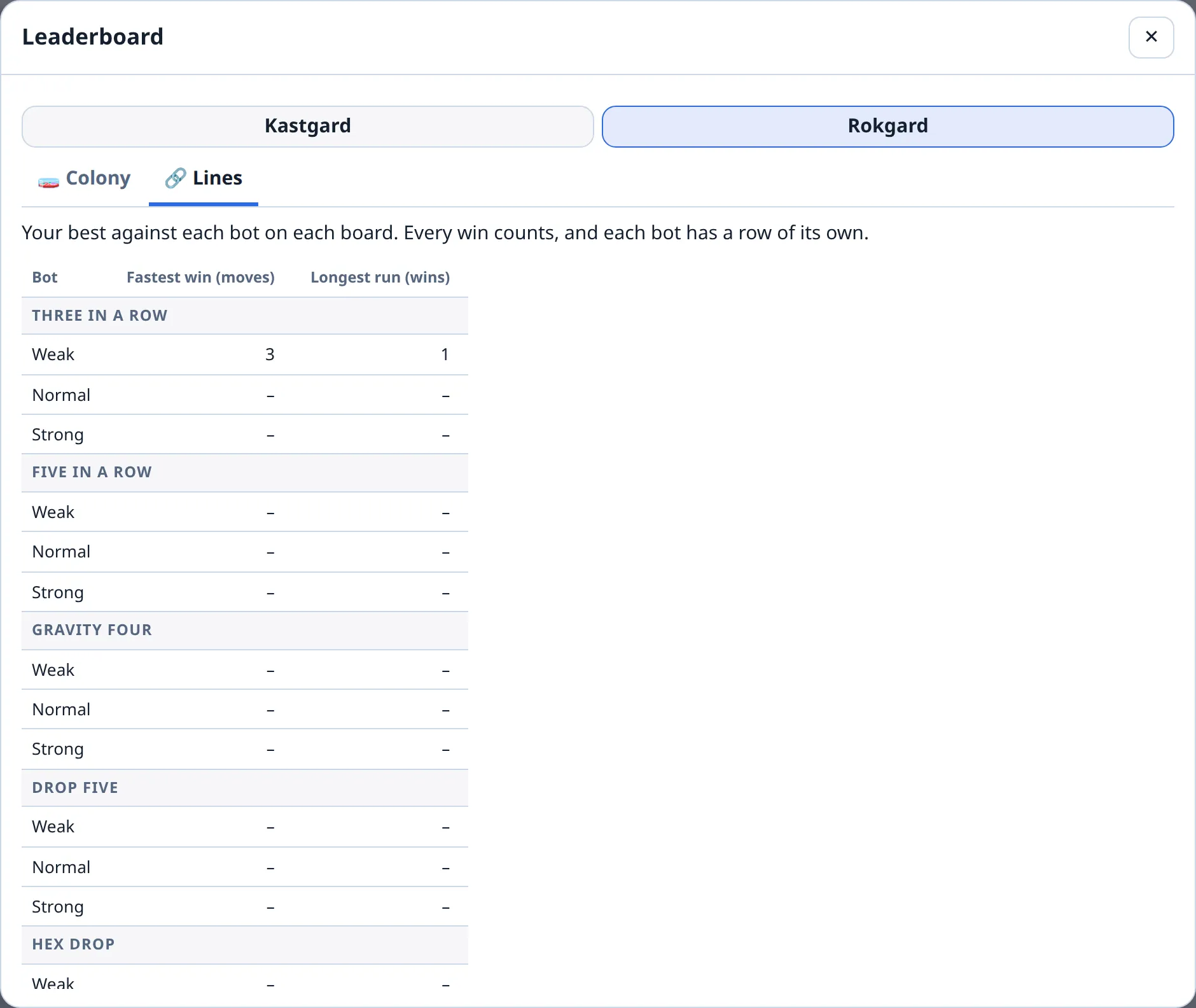
Open according to the document is a decimal score. The table shows whole moves, and the XP of a game stays whole. The document discusses three paths: A whole numbers (built), B a derived decimal number on the card, C XP and tokens with decimals everywhere. Rounding up would give a win on average 0.11 to 0.25 XP more, about 1% of a win. Further open items: the end of a game does not say that a record fell, and Rokgard's statistics have no button to the leaderboard.
What is decided and what remains open
Decided: rules, score and leaderboard for Rokgard (1 Nov); twelve questions of the leaderboard, two of them differently from the advice (1 Nov); tokens and Golden dice are balanced later; records under rec, and counting all three AI opponents and every win.
Open: the decimal score, the "New record" line on the end-of-game card, and the leaderboard button in Rokgard's statistics.
What I take from it
- Text read from data can be guarded by a test. A hand-written card would silently stop being true.
- Statistics and records ask different questions. A count of finished games does not say which of them paid. Three entries of one game are fine when the rule is written once and the numbers are not shared.
Sources and notes
- Game status: version 0.97.1 (3 Nov 2026); change log, versions 0.84 and 0.97.
- Game documents: chapter 129 of the design document (the rules card) and the leaderboard document with chapter 140 of the design document. The rates and multipliers are in the data of both games. The hour figures 151 and 82 are my own calculation.
- Related articles: Colony, The score that did not know how long a game lasts, From one game, more games: realms.