
part 26
When a row stops being played: a line of 6 or more and a preset that added nothing
The Lines configurator allowed a line of up to 8, because it fits on the board. Measurements of the AI opponents showed that from a line of 6 the games end in a draw once the board is full, and the preset Quick drop is Gravity four one row shorter.
The Lines configurator (Lines in Slovak: Čiary) appeared in the game on 31 October 2026. It lets you set the size of the board, the length of the line, gravity and a few presets. My two remarks from the first play, almost word for word: a line longer than 6 is already unplayable, and I doubt that six is playable either; and the preset "Quick drop" (a 7 × 5 board, a line of 4) is pointless when "Gravity four" (a 7 × 6 board, a line of 4) exists. Both things could be measured, so they were measured. This is the second article in the series about Lines, after the article about three in a row.
The result is clear: a line of 6 or more is not playable, and Quick drop is the same game, four moves shorter. More interesting than the finding itself is why playing caught it and not the measurement that was made of the configuration beforehand.
Why 8 was a reasonable number
The analysis of the configurator (docs/LINES-CONFIGURATOR.md, section 2.3) proposed a range of 3 to 8 for the length of the line. The reasoning was geometric: a line of 2 is won on the third move on every board, so it is not a game, and above 8 the line does not fit on most boards at all.
That is a question of "does it fit?", not "can it be played?". The limits on the size of the board (3 to 25 columns and rows, at most 400 cells) were measured against the time of an AI move and the size of a cell on a phone. The length of the line was not measured against whether a game still means something. So the limit of 8 says where a line does not fit, not where a game ends.
What was measured
The measurement is made by the AI of the game. The AI of level 2 looks four moves ahead and examines at most 20,000 positions; two such AI opponents play against each other and the results are added up. It is a measurement of AI opponents, not of people (more on that in the section on what was not measured). There are two sources for the numbers:
- Tables from the analysis (40 games per board, each game starts with two random moves so that the games do not all start the same way): a line of 4, a line of 5 and a line of 6 without gravity, a line of 4 and a line of 5 with gravity.
- A new run from 31 October 2026 (20 games per board, the seats and the first move alternate, without random opening moves): a line of 6, 7 and 8 with gravity on the larger boards that the tables did not cover.
What can be seen from it:
- Without gravity a line of 6 is dead on every board up to 15 × 15. The draw is in 98 to 100 % of games. The table of the analysis shows the same thing for the boards 6 × 6, 7 × 7, 8 × 8 and 9 × 9: 100 % draws. Notable too is that a game lasts as many moves as there are cells: 36 on a 6 × 6 board, 49 on 7 × 7, 64 on 8 × 8, 81 on 9 × 9, 221 out of 225 on 15 × 15. The two AI opponents never complete the line, they play out the board.
- With gravity a line of 6 on a 9 × 8 board is a draw in 75 % of games, on 12 × 10 in 65 %. On a 15 × 12 board only 25 % are draws, but a game lasts 174 of 180 moves on average: it is not a quick line but a marathon (each player makes over eighty moves). A line of 7 on 12 × 10 gives 65 % draws and a line of 8 on 15 × 12 gives 85 %.
- A line of 5 is fine only on a large board. Without gravity 90 % of games end in a draw on 8 × 8 and 68 % on 9 × 9; on 10 × 10 it is 23 % and on 15 × 15 none. With gravity a 6 × 5 board gives 88 % draws, a 7 × 6 board 58 % and a 9 × 8 board (the preset Drop five) 23 %.
That last figure also shows how the uncertainty should be read. Drop five gave 23 % draws in the table of the analysis (40 games), and 5 % in the new run (20 games, a different way of starting the game). A difference of 18 points looks large, but with 20 to 40 games the uncertainty of a share is on the order of ±10 to ±20 percentage points (the tool prints ±21.7 points for a score at 20 games). That is why the numbers in the chart are read as orders of magnitude: 0 to 30 %, 50 to 70 %, 90 % and more. The difference between a line of 5 on a 9 × 8 board and a line of 6 on a 9 × 8 board (23 or 5 % against 75 %), however, is much larger than any noise.
Why this happens (reasoning, not a measurement)
On a large board a line of 4 needs only an open three: three stones in a row with both ends free. The opponent can block one end, the other stays open, and the first player completes the line. The analysis finds that this way the first player wins on boards 6 × 5 and larger in 9 to 14 moves. With a line of 6 the same unstoppable position would have to be an open five, and that takes five moves to build. The opponent has five moves in the meantime to build up to it from both sides, and an AI of level 2 looks four moves ahead, so it recognises the threat before it becomes unstoppable. This is a reasoning about the shape of the game, not a measurement of individual positions, but it matches the numbers: the longer the line, the more draws.
What Connect6 does with it
A line of 6 makes sense in a game that is called exactly that: Connect6. It was invented by I-Chen Wu and presented in 2003. The first player places one stone, and then each player places two stones per move; the winner is the first to get six in a row. Two stones per move even out the advantage of the first player and make a long line a battle. The analysis examined it (section 5.3, the rule "1-2-2"): on small boards it turns the first player's win into a draw, but for boards above 30 cells the tree grows so much that the solver is not enough. It is a different game, not a further slider position: a move of two stones changes the screen, the AI and the saving. A long line in Lines is therefore not an "unfinished option" of the configurator; it needs its own rule.
Quick drop and Gravity four
The preset Quick drop (7 × 5, a line of 4, gravity) was made as the "shortest balanced board". Comparison with the preset that the game has had from the start:
| Gravity four | Quick drop | |
|---|---|---|
| board | 7 × 6 = 42 cells | 7 × 5 = 35 cells |
| possible lines of 4 | 69 | 50 |
| AI opponents of level 2 (first / draw / second) | 50 / 10 / 40 % | 50 / 20 / 30 % |
| average length of a game | 34 moves | 30 moves |
| perfect play | the first player wins | draw |
| meets the criteria of "interesting" | yes | yes |
Sources: the tables of the AI opponents on boards with gravity and the boards solved exactly in docs/LINES-CONFIGURATOR.md (4.2, 4.3, 7.3); the value for 7 × 6 under perfect play comes from the known result of Connect Four (the standard 7 × 6 board, solved in 1988: with perfect play the first player wins). The solver of the game does not reach 42 cells within its budget.
The differences: a game about four moves shorter (roughly 12 %), about ten points more draws (within the noise at 40 games) and a different value under perfect play, which a player will never see. It is played the same way; it is recognised by the length of the game, not by a feeling. My question whether this is a faster version of the same game got the answer: yes, and nothing else.
What the filter did not catch
Both presets have a "yes" in the table, so they meet the criteria of interest from the analysis: the first player scores 45 to 60 %, draws are at most 40 % and the game is not trivial. The filter says whether one configuration is interesting. It does not check whether two interesting configurations differ. The list of presets needs a second criterion: the distance from the neighbours (the length of a game, the size of a cell on a phone, the result of the AI opponents), and a rule that a preset which differs from another by less than ten percent does not belong in the list. The threshold can be derived from the uncertainty of the measurement: as long as the difference is smaller than the noise, it is one game.
The decision
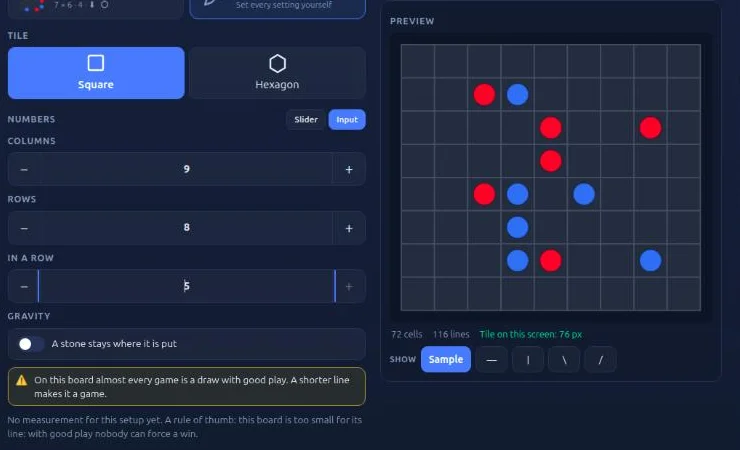
My decision of 31 October 2026 has two parts: the length of the line is at most 5, with an amber warning (it does not stop Start) for a line of 5 on small boards, and the preset Quick drop is removed. The presets Three in a row, Five in a row, Gravity four and Drop five stay, plus Your own. The game is not released, so nothing is removed that somebody may have saved, apart from me.
The revision of the task separates clearly what the screen offers (a limit of 5) from what the rules can still play: a game, a record or a saved state made with a line of 6 to 8 must be possible to restore and play out as it was, because a record is a fact and not a choice. The thresholds for the amber warning are not taken from judgement but from a measurement: for a line of 5 the same run of AI opponents is made on squares with and without gravity, and the results decide on which boards the warning appears. The change has been in the game since version 0.65.11 (31 October 2026, docs/DESIGN.md §99). The amber warning does not stop Start: it is advice, not a prohibition. Red errors, which block the game, are a different kind of notice.
What was not measured
- People. A draw between two AI opponents is not a draw between two people: a person makes mistakes that the AI does not try, and waiting for six in a row may be fun for someone. The claim "unplayable" means "the AI always stops", and "a person does not see where to play", not a measurement of satisfaction.
- Level 3. The stronger AI (14 moves ahead) was not run on the line of 6. The analysis shows that on other boards it is the same map, only sharper.
- Larger boards with gravity and a line of 6 to 8. The run stopped at the 15 × 12 board (180 cells), where a game already lasts 174 moves. On a larger board a draw would be even less likely, but a game even longer, and that would change nothing about playability.
- Two stones per move in the game, which the configurator does not offer.
- Sample size. Hundreds of games per board would narrow the intervals; the decision does not rest on that, because the differences between a line of 5 and a line of 6 are many times larger than the noise.
Sources and notes
- Measurement of 31 Oct 2026:
chains.js --matrix --levels 2 --games 20over the six boards of the graph (game 0.65.6): 20 games per board, wins, draws and moves; the average length of the games is 71 to 179 moves. - Tables and limits:
docs/LINES-CONFIGURATOR.md2.3, 4.1 to 4.3, 5.3 and 7.3; the decision and its revision indocs/DESIGN.md§96 and §99 (version 0.65.11). - Connect Four and Connect6 (Wikipedia, read 31 Oct 2026): Connect Four is a solved game, with 7 × 6 the first player wins; Connect6 was invented by I-Chen Wu in 2003.
- What could not be verified: the impression of real players, the behaviour of the stronger AI (level 3) with a line of 6 and more, the value of 7 × 6 with gravity (from the literature). The thresholds of the amber warning come from the measurement in §99.3, not from players.