
Lines
One stone per turn on an empty cell; whoever first makes a line wins. Presets from Three in a row to Drop five.
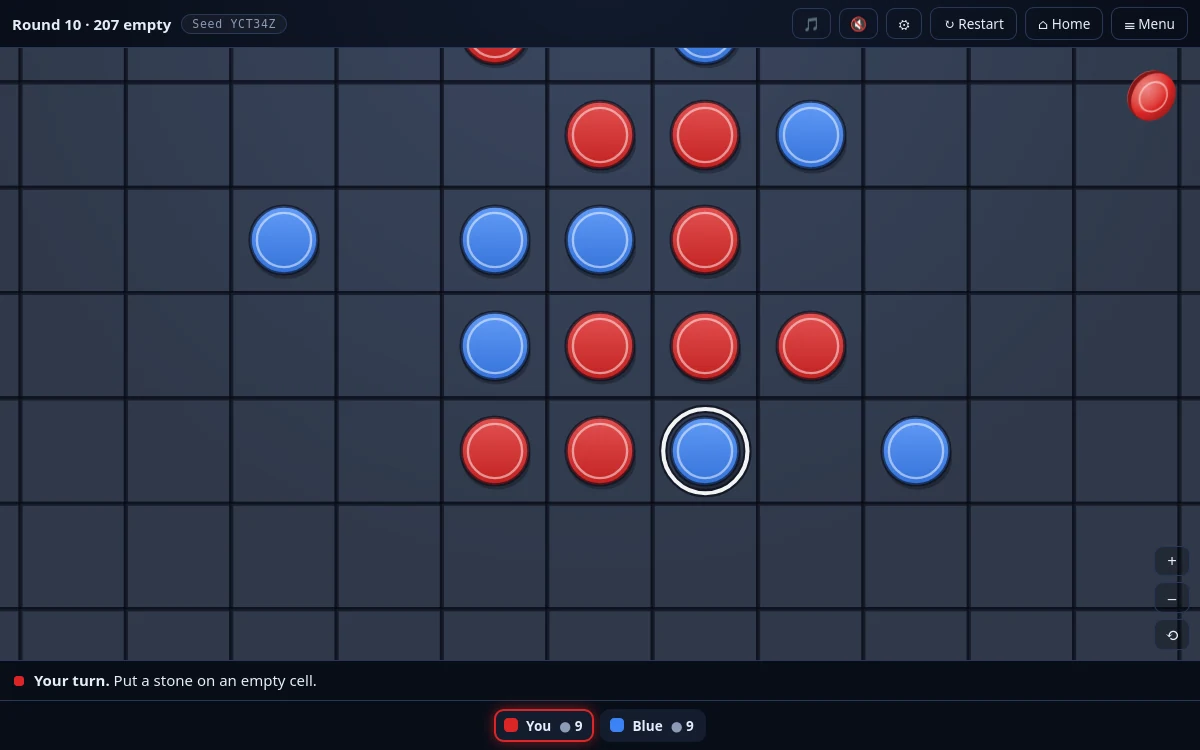
Lines is the second game of the realm Rokgard: you and an AI take turns putting stones on empty cells, and whoever first makes a line wins. It has no dice and stones are never captured. Two players play it.
Rules
- One stone per turn, on an empty cell.
- The first to have the required number of stones in a row wins: across, down or along a diagonal (in three directions on hexagons).
- With gravity the stone falls to the lowest empty cell of the column you pick.
- When the board is full and nobody has a line, it is a draw. There is no other draw.
- On a touch screen the first tap marks the cell and the second plays.
Presets
The kind of game is chosen on the first screen. The last column is what the game itself shows with a preset: how a game of two Normal AI opponents went.
| Preset | Board | In a row | Gravity | First player wins / draw |
|---|---|---|---|---|
| Three in a row | 3 × 3 | 3 | no | 0% / 100% (solved) |
| Five in a row (default) | 15 × 15 | 5 | no | 73% / 0% |
| Gravity four | 7 × 6 | 4 | yes | 50% / 10% |
| Drop five | 9 × 8 | 5 | yes | 48% / 23% |
| Hex drop | 7 × 6 hexagons | 4 | yes | 18% / 0% |
| Your own | as you set it | 3 to 5 | as you set it |
Your own game is set up as the section Setting up a game says. A line longer than five ended almost always in a draw in the measurements, which is why the limit is five.[1]
Three in a row has a page of its own: Three in a row: how not to lose.
Setting up a game
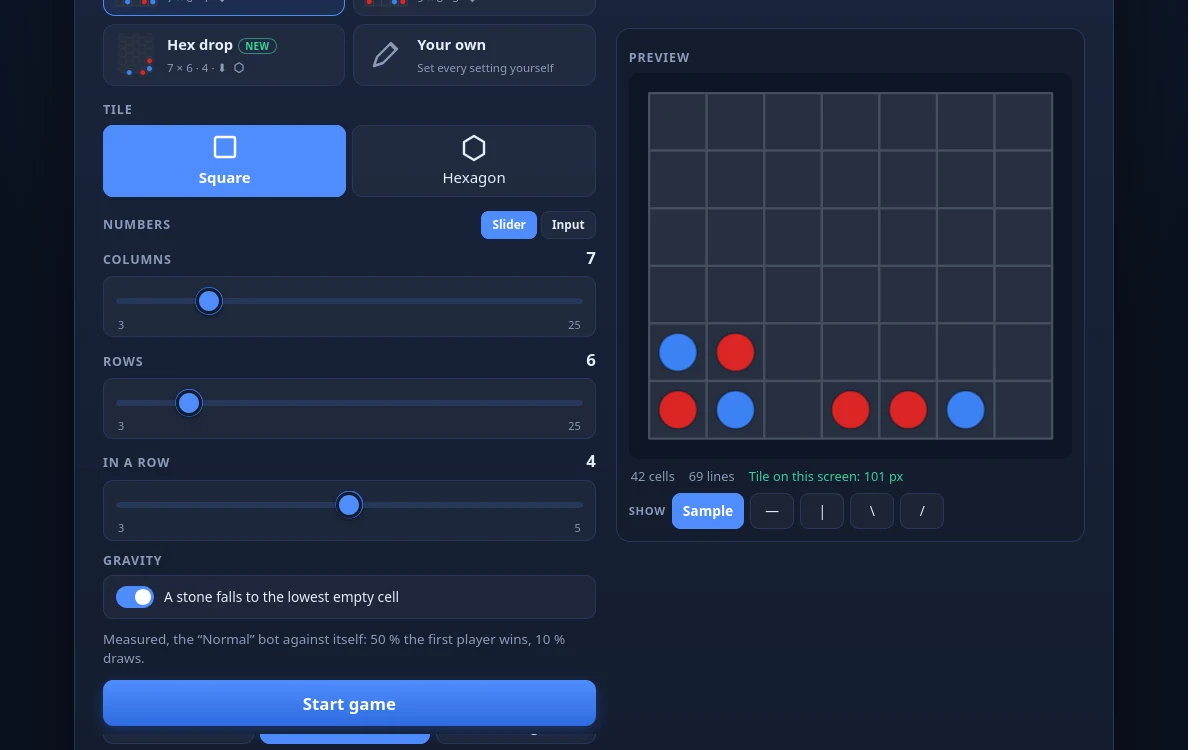
The choices are on the left, the preview of the board on the right (above the choices in a narrow window) and the button Start game is always within reach. The default is Five in a row with sliders, a Normal opponent and the first move yours.
| Option | Values |
|---|---|
| Variant | a preset from the section Presets, or Your own |
| Tile | square, hexagon |
| Columns | 3 to 25 |
| Rows | 3 to 25 (columns times rows at most 400 cells) |
| In a row | 3 to 5 (not more than the longest row that fits on the board) |
| Gravity | off, on |
| Opponent | Normal, Weak, Strong |
| Who starts | you, the opponent, random |
Choosing a preset sets every option under it. When you then change the tile, a number or the gravity, the game moves the variant to the preset that has exactly these numbers, or to Your own: a preset never changes under your hands. The numbers can be set with a slider or by typing (the switch Numbers), the preview is redrawn while you drag a slider, and the buttons Show mark one line in it so that you can see what "in a row" means. The line under the gravity says what was measured on this board (a game of two equal opponents), or a rule of thumb when there is no measurement. A board that cannot be played (for example a line longer than the longest row) has a red warning with a button Fix, and Start game waits; an amber warning is only advice.
The game remembers the setup of the last game you started, also after you close the page (with whether the numbers are sliders or fields). A change after which you do not start a game is not remembered.
Opponents and rewards
The AI has three levels, Normal is the default. A win pays as in Colony (Colony), with the rules of the board: a board of 36 or more cells pays in full, a smaller one in proportion; a board without gravity and with a line of at most 4 pays a quarter; a game won in fewer than 6, 8 or 10 moves (a line of 3, 4 or 5) pays nothing. Three in a row therefore never pays. The card at the end of a game says when a game paid no experience.
Notes
- See (forthcoming article no. 26). ↩︎