
Principalities: what follows from the measurements
The first move, skill, the levels of the AI and the placing of reinforcements in Principalities according to the measurements in the blog (AI opponents were measured, not people).
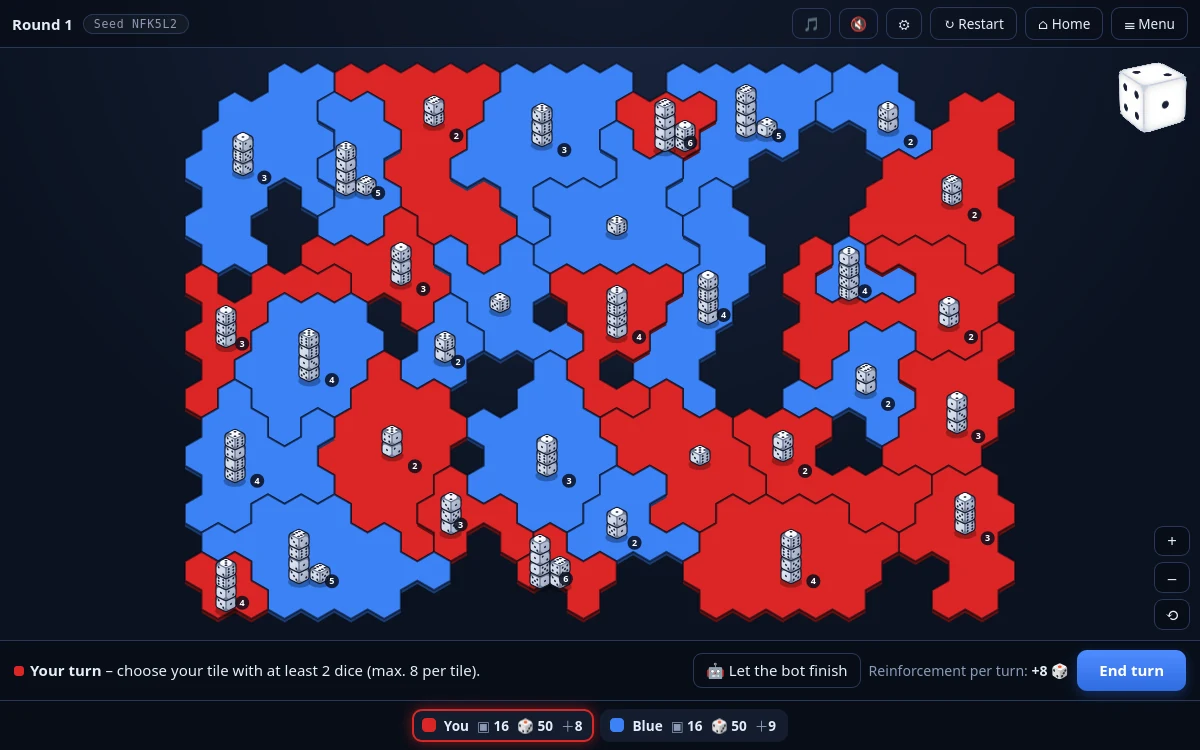
The numbers on this page come from measuring AI opponents. The articles they are from repeat it: an AI is not a person, and the strategy of people could not be measured. The rules are on the page Principalities.
The first move
Two equally good AI opponents that alternate in a duel give the starting one 93.3% of the games; with 3 players 61.3%, with 4 players 41.8% (the fair share is 25%) and with 8 players 15.8% (12.5%). With 4 players it was 400 games per cell (±5 percentage points). That is why the game draws who starts; with 4 players the seats won in order 24.8, 22.8, 28.0 and 24.5%. The alternative, extra dice for the second player, was too sensitive: without them the first wins about 95%, with +25% 56% and with +50% 9%. In a duel the game tells the player that it matters most who starts.[1]
Skill
With two players skill hardly shows (52% for an average AI and 55% for a good one), because a duel is decided by the order. The more players, the more decisions: a good AI (level 3) wins 51% with 4 players (the fair share is 25%) and 47% with 8 players (13%). More about the AI is on the page Opponents.
Reinforcements and placing them
By the rule the reinforcements go to random territories (Principalities); in Free play there is the option "I place them". In the measurement an AI that put all the new dice into the biggest stack at the front won 99% of the games in 6 rounds in the basic setup, while with the random placement of the AI it won 35% in 10 rounds and with a fully random one 34% in 34 rounds. The opponents in the game do not stack dice. The game therefore values manual placement at −41 points of the score (earlier +2). Stacking as a human practice is an observation of the author, only AI opponents were measured.[2]
What makes a game longer and easier
- The length of a game against a level-3 AI is raised by: reinforcements by half of the territories ×2, at most 36 dice per territory ×1.7 and the archipelago map ×3; moving half of the dice changes nothing.
- The difficulty of settings is measured in points: 1 point is a drop of 0.125 in the log-odds, about 3 percentage points near 50%. The defender bonus +4 costs about 8.6 points. The points do not add up exactly: the result differs by 15 to 40%, so they serve for comparing settings, not for predicting a chance.[3]
What was not measured
A simple "best move" in Principalities was not found. Attempts with tuned weights and Monte Carlo did not beat the Strong AI, and the game is largely luck.[4]